Sector Guide6 min read26 June 2026

Web Design for Bathroom Fitters in London: Win Renovation Contracts From Google Before the Three-Quote Stage

London's bathroom renovation market is driven by ageing bathroom stock in Victorian and Edwardian properties, buy-to-let landlord investment, and a growing demand for wet rooms in space-constrained flats. A bathroom fitter website that shows the right portfolio and ranks for local searches can fill a diary without a single directory listing.

web design bathroom fitters londonbathroom installer website londonbathroom fitter website london
Web Design for Bathroom Fitters in London: Win Renovation Contracts From Google Before the Three-Quote Stage

01

Wet room pages: the premium project category that deserves its own page

Wet rooms command significantly higher project values than standard bathroom refurbishments — typically £6,000–15,000 in London — and require specialist knowledge of tanking systems, linear drain installation, waterproof membrane specification and slope-to-drain floor preparation that separates a competent wet room fitter from a generalist. A dedicated wet room page with before-and-after photography, a clear explanation of your tanking and waterproofing approach, your preferred linear drain products and a walk-through of how you handle the wall-to-floor junction — where most wet room failures originate — positions you as a specialist rather than a generalist taking on a job beyond their core competence. Clients searching 'wet room installer London' have usually already decided they want a wet room and understand it requires a specialist, which means they arrive on your page pre-qualified, with a realistic budget expectation and a stronger intent to commission than a general bathroom refurb enquiry. Wet room case studies showing the before state, the waterproofing stage and the finished installation give confidence to clients who are spending significantly and want to see the process, not just the result.

02

Landlord and HMO bathroom pages: a distinct client type with different priorities

Landlords and HMO operators searching for bathroom refurbishment are motivated by durability, fast turnaround, minimal tenant disruption and cost control — a completely different set of priorities to a homeowner who wants a luxury wet room finish and will live with the result for fifteen years. A page targeting 'landlord bathroom refurbishment London' or 'HMO bathroom fit-out London' should address these priorities directly: how quickly you can complete a bathroom to a good rental standard, what product ranges you recommend for durability in a multi-tenant context, how you manage installations in occupied properties and what your day-rate or fixed-price structure looks like for repeat work. A landlord with three properties will become a recurring client if your first installation is clean, fast and within budget — the website page that attracts that client in the first place should speak to a property investor's operating mindset, not a homeowner's aspiration. Including a note on HMO-specific bathroom requirements — minimum fixture counts, ventilation standards, accessibility considerations for larger HMOs — signals familiarity with the regulatory context and positions you as a contractor who will not need to be educated on compliance.

03

Supply and fit vs fit-only: capturing both search types

The homeowner who has spent three months choosing a Crosswater suite and Porcelanosa tiles from a showroom needs a fitter who can receive, check and install products they have already purchased — a distinct service from the homeowner who wants a bathroom fitter to manage the entire project from product selection to installation. A page explaining both options — what supply and fit includes (product selection guidance, procurement, delivery management, installation, waste removal, snagging), what fit-only covers and what each option costs as a guide — captures both search types without turning away either client. 'Fit my own bathroom London' and 'bathroom fitter to install my suite London' are actively searched by homeowners who have bought products and want installation only, and these searches are often underserved by bathroom companies whose websites only describe full project services. Explaining your process for each route — how you review a product specification before accepting a fit-only job, how you handle missing or damaged items on delivery — builds confidence and manages expectations before any conversation, reducing the administrative burden of onboarding new clients.

04

Photo quality and organisation: how London bathroom fitters lose jobs before they answer the phone

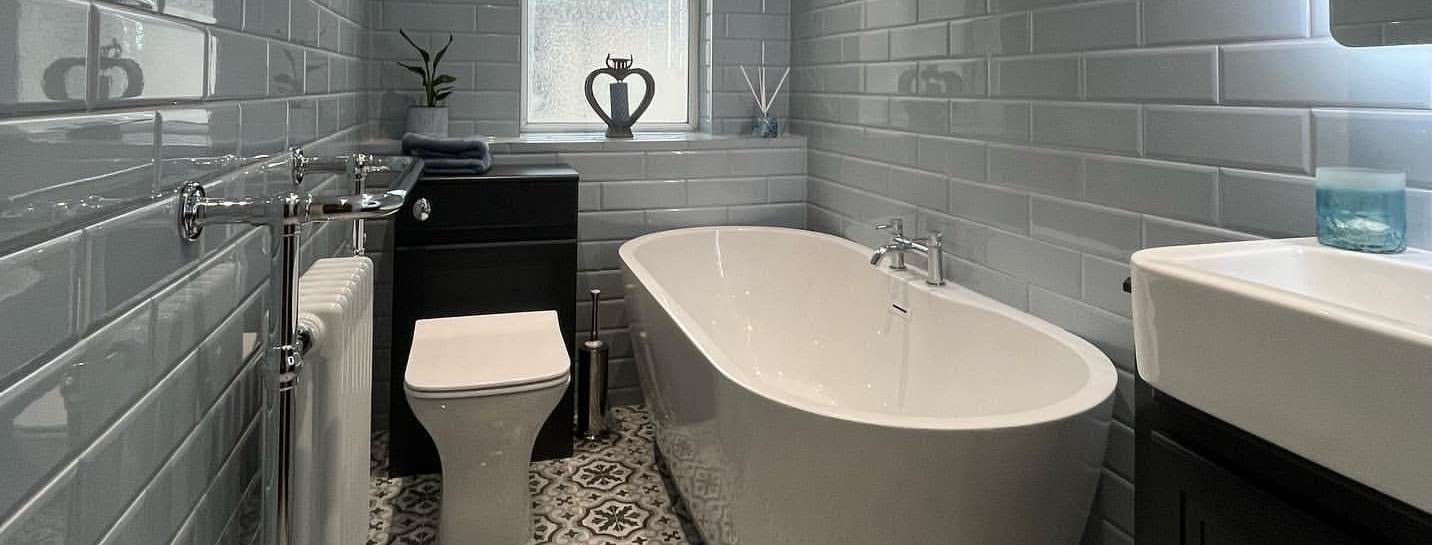
Bathroom photography is technically demanding — tiled surfaces under downlighting produce green colour casts, small rooms distort with the wrong lens, and poorly framed shots that cut off tile runs or hide grouting quality make even excellent work look mediocre. A completed bathroom installation should be photographed with the door removed to show full room depth, a wide-angle lens set at floor level to capture the tile run from floor to ceiling, and supplementary lighting to eliminate the green cast from bathroom downlights. Organising the gallery by suite type — contemporary, traditional, en-suite, accessible bathroom — and by material — marble effect, Metro tile, natural stone, geometric floor tile — makes it easy for a visitor to find the style closest to their brief and immediately see that you can deliver it. The difference between a gallery of thirty well-lit, well-composed installation photographs and thirty smartphone shots taken at the end of a job will determine whether a potential client makes contact or clicks back to a competitor, regardless of how similar the underlying installation quality actually is.
Ready to get started?

Websites from £1,000. Built in London.

Start a project

Related services

Turn the research into a project.

These service pages connect this guide to the specific scope that fits your business.